Introduction
Imagine building a high-rise building or designing a pressure vessel to hold hazardous chemicals with no blueprints. The level of unpredictability would be huge, with bad results most likely due to not having a design or engineering plan to work from. The welding industry is just like this when companies do not have an approved Welding Procedure Specification (WPS). In the world of fabrication, welding is often the weakest link in any structure due to the way materials are joined together to create load-bearing joints, pressure containment joints, or to provide stability or support.
For a fabrication company wanting to be successful in today’s marketplace (that can be both in India and globally), the quality and repeatability of their welding operation will allow or condemn their reputation. Simply put, a welder cannot produce consistent quality by using his or her best guess or memory. By controlling and documenting welding variables such as heat input, interposes temperature and filler metal selection, a quality product will be achieved. Establishing a proper WPS for the processes of the fabrication company is the first step toward becoming a professional and reliable company.
Why Every Fabrication Company Needs Approved WPS
In fabrication, welding forms the basic framework for structural integrity, but using welding without an established guideline could be like sailing a ship without a compass. The Welding Procedure Specification (WPS) helps to provide this guideline. For any company wanting to produce quality workmanship while maintaining safety and compliance, an approved WPS is essential. A properly implemented WPS for fabrication company processes will ensure that all welding results in a finished product of high quality and safety, thereby protecting both employees and customers.
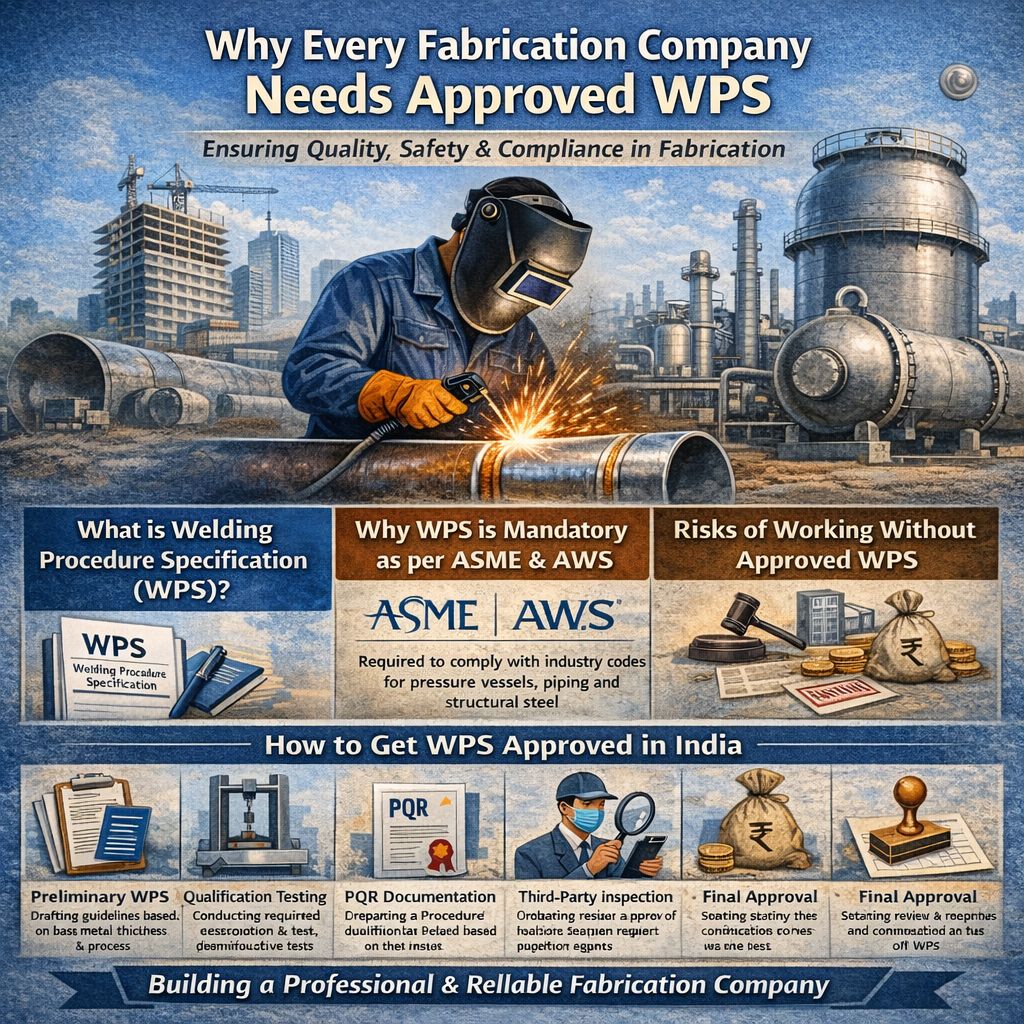
What is Welding Procedure Specification (WPS)?
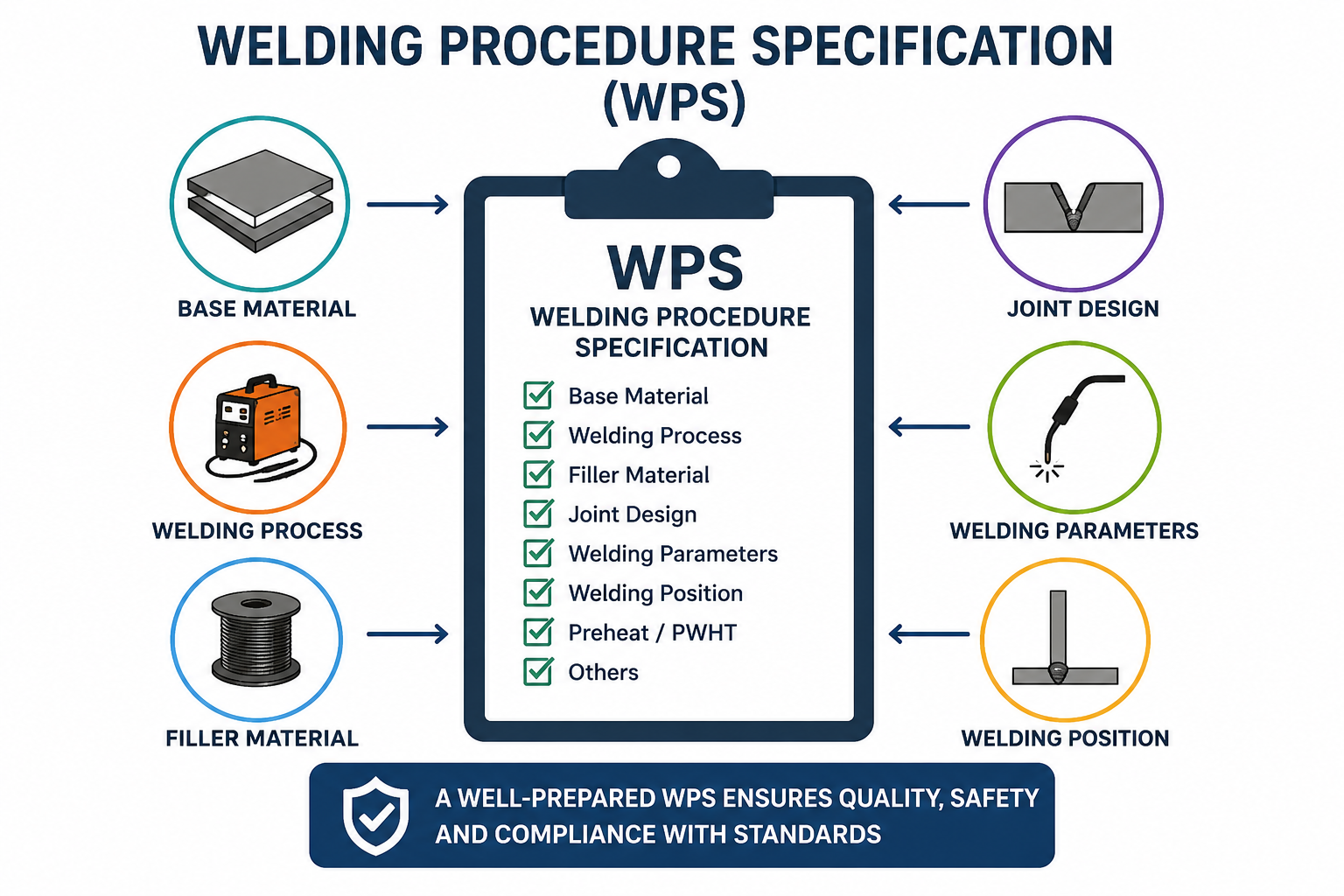
A welding procedure specification (WPS) is a formal written document that provides direction to the welder or welding operator to ensure consistent and repeatable production of sound welds. A WPS defines the variables of the welding application, including the type of materials being used, the design of the joints, the positions in which the welds will be made, the necessary preheating of the material prior to performing the weld, the required post heating of the weld once it is completed, as well as electrical characteristics related to the weld process.
It is important to note that a WPS is supported by a procedure qualification record (PQR) which documents actual data from the test weld that confirms the validity of the WPS. For fabrication companies, having an appropriate WPS for fabrication company format creates an established method that can be reproduced consistently across various projects or work shifts.
Why WPS is Mandatory as per ASME & AWS
The American Society of Mechanical Engineers (ASME) and the American Welding Society (AWS) require using Welding Procedure Specifications (WPS); for all welding done per their codes, whether it is a pressure vessel or piping coded by ASME, or a structure built with steel coded by the AWS. Although they are both codes for different industries, they follow the same principle that if the WPS is not approved, the work is not in compliance with that code.
The difference between the ASME and AWS codes related to how the WPS can be established is a fundamental difference between both of their codes. With the ASME Section IX code, you must have a Procedure Qualification Record (PQR) to support the WPS by performing a test to verify the mechanical properties of the weld. In contrast, the AWS D1.1 code allows for the use of prequalified WPSs based on common joint types and materials, therefore, allowing the shop to eliminate physical testing as long as the parameters of the code are followed exactly. Understanding these differences is crucial when looking for the right WPS for use by a fabrication company based on which industry code they are working with.
Risks of Working Without Approved WPS
Without having an approved work procedure specification (WPS) to follow, there are many legal, financial, and safety risks associated with it for a fabrication company.
1.Legal and Regulatory Compliance:
There are rules in many areas which adhere to certain standards; for example, AWS D1.1 or ASME, for commercial construction and industrial projects. If a fabricator is inspected and does not have a validated WPS, they can be charged with a violation, which could lead to work stoppage or litigation.
-
Catastrophic Failure:
Without a uniformed procedure, the integrity of the weld is unknown. This could lead to structural failure or pressure failures, both of which could result in loss of life and property.
-
Financial Loss:
Many times, rework and repair are expensive. If a client’s inspector rejects a weld because of no welding procedure is available from the specified fabrication company, the fabricator has to cover the costs associated with the re-fabrication of that component, creating a delay in the project and contributing to penalties.
How to Get WPS Approved in India
Usually, when seeking a WPS approval in India, the procedure follows both the ASME/AWS and Indian Standards and typically involves the following steps:
-
Developing a Preliminary WPS:
Developing the WPS based on the base metal, thickness of material, and process to be used.
-
Keeping a record of Procedure Qualification:
Completing the procedure qualification in accordance with the relevant code (ASME IX or AWS D1.1).
-
Performing Tests:
Performing destructive and non-destructive tests on the test coupons at an approved laboratory (e.g. Tensile; Bend; Impact; Radiography, etc.).
-
Preparing Documentation:
Preparing a Procedure Qualification Record (PQR) to show how the test coupons were tested to qualify the WPS.
-
Obtaining Third-Party Approval:
For critical jobs, the Welding Procedure Speccification will be reviewed by an engineer or an authorized inspection agency (e.g. Lloyds, TUV, BVIS) to verify that the WPS has been correctly qualified for the fabrication company.
Conclusion
The fabrication company’s approved WPS is their license to operate in a world where quality and safety take precedence. The WPS serves as the link between engineering design and shop floor, assuring consistency, traceability and compliance. Developing and having full approval of a WPS for fabrication companies is more than mere regulatory compliance; it is a business decision that enhances the businesses reputation as a reliable entity. With continuous amendments to welding codes like AWS D1.1, all WPS for fabrication companies must be kept up to date to keep pace with their competition and provide for necessary implementation of current revisions (examples include the 2025 revisions concerning preheat and documentation).
FAQ Section
- What is the difference between a WPS and a PQR?
A WPS is the manual for welding or the recipe for welding. A PQR is how you show that the recipe works, or the laboratory report with the actual test results from the weld performed to prove the WPS.
- Can a fabricator use the same WPS from a previous job for the new job?
Yes, with limitations. A pre-existing Welding Procedure Specification may be utilized on a new project only if it has been supported by a valid PQR and within the essential variable ranges (like material type, thickness, and welding process) specified in the code for that new project. This is known as a “Supplementary WPS” under ASME.
- What are the “Prequalified” WPS as defined in AWS D1.1?
Under AWS D1.1, Prequalified Welding Procedure Specification allow fabricators to weld structural steel without having to perform a qualification test for certain common joint details, and/or materials, so long as it is done according to the specific parameters of the code. The benefit of this is time and money; however, the welders must still complete the work according to WPS for fabrication company guidelines.
Articles/Websites References:
- AWS Main Website:
https://www.aws.org - AWS Codes & Standards Portal:
https://www.aws.org/standards - ASME Main Website:
https://www.asme.org - ASME Boiler and Pressure Vessel Code Section IX (Official Page):
https://www.asme.org/codes-standards/find-codes-standards/bpvc-section-ix-welding-brazing-fusing-qualifications - Weld Guru – Welding Procedure Specification (WPS) Guide:
https://weldguru.com/welding-procedure-specification/ - The Fabricator – ASME and AWS Welding Codes Overview:
https://www.thefabricator.com/thefabricator/article/shopmanagement/asme-and-aws-welding-codes-similarities-and-differences - Bureau Veritas
https://group.bureauveritas.com - Bureau of Indian Standards (BIS)
https://www.services.bis.gov.in - American Society for Nondestructive Testing
https://www.asnt.org