Introduction
Welding is a fundamental part of modern construction, manufacturing and infrastructure. It is the basic and often unseen glue that binds our built environment together, from the enormous scale of bridges and buildings down to the cars we drive, the pipelines that transport our resources, and the appliances in our homes. By and large, welding goes unnoticed by the general public; which is why the welding inspector’s responsibility is so important. They are an independent quality and safety advocate, serving as the last line of defence against structural failure. The welding inspector is responsible for a thorough and detail-oriented verification process that starts well before the first spark is struck, and continues until the final product; involved in verifying everything from the welder’s qualification and the qualification of the equipment that he/she is using to the quality of the weld itself.
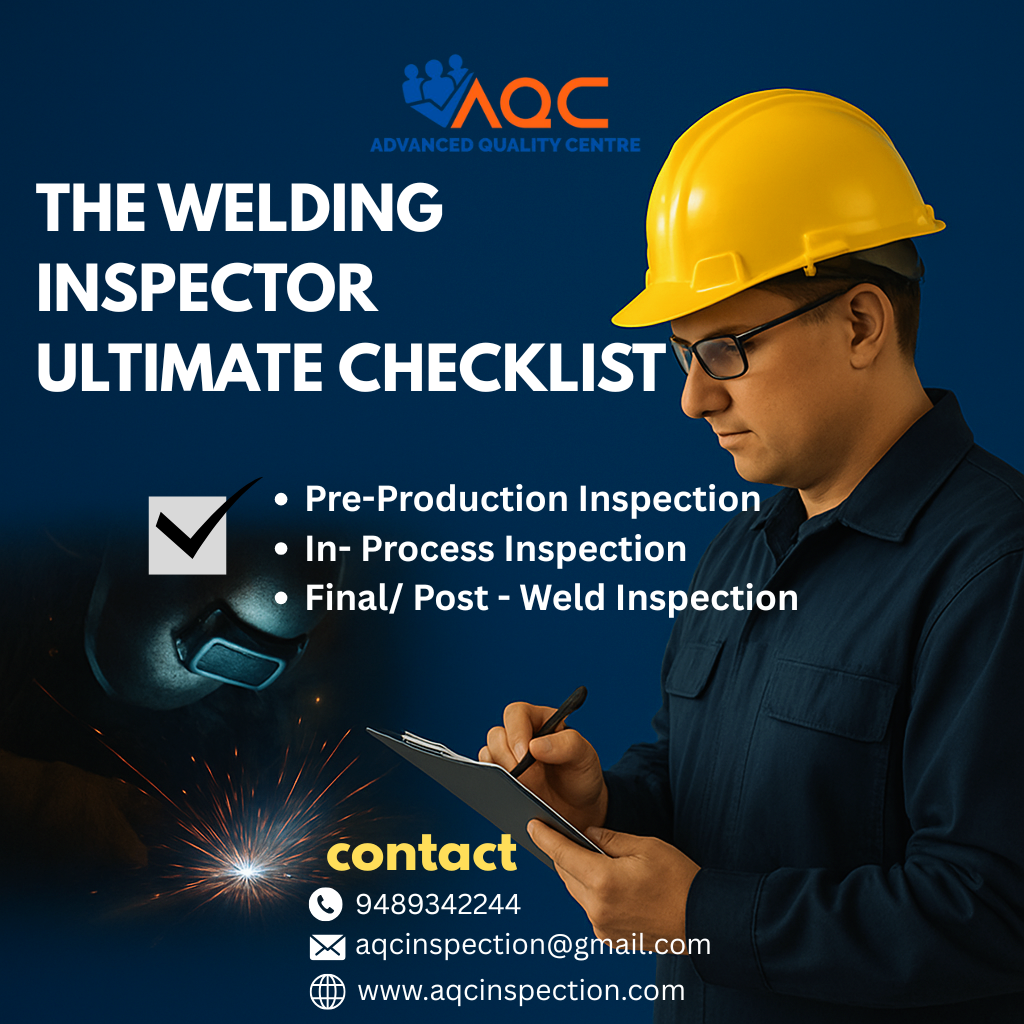
The three-part philosophy: Pre-inspection, In-process inspection, and post-inspection.
- Pre-Production/Pre-inspection: Verifying everything that occurs before the arc is struck.
- In-process inspection: Monitoring the procedure and operator during welding.
- Final/post-weld inspection: Inspecting the completed weldment.
Phase 1: Pre-Production Welding Inspection
This first phase of Welding Inspector checklist is the most important. Identifying a problem at this phase can prevent future costly rework and downtime.
The WPS is the recipe for creating the weld, and the PQR is the evidence that the recipe works. The inspector needs to verify:
- An approved WPS is available for every joint design and material type
- The supporting PQR is valid and qualifies the WPS within the essential variables needed by the relevant standard.
- The WPS is being presented to the welding crew
-
Verify Welder and Machine Qualifications
Recipe or not, even with the best recipe possible, without the capabilities of a great chef, the recipe is of no value. Checking everything needed:
- Welder Certifications: Before a welder can legally weld, they must possess a valid welder qualification record (e.g., a welder performance qualification – WPQ) for the welding process (SMAW, GTAW, etc.), material type, comparing thickness and position, as required for the job.
- Equipment Calibration: Everything, such as welding machines, gauges (for gas flow), and without flirting, all equipment must be properly calibrated and maintained.
-
Material Verification and Traceability
“Garbage in, garbage out” is particularly applicable to where welding operations are concerned. Inspect material for the following:
- Material Grade: Make sure, through mill tests/reports/certificates, that the material is correct as per project specifications; base metals and consumables (rods, wire, flux) should be verified.
- Material Condition: Inspect for the material being damaged, being corroded to an excessive amount, or conflicting identifying markings.
- Material Storage: Ensure consumables are stored correctly. For example, low-hydrogen electrodes should be stored in ovens as per manufacturer’s instructions to avoid moisture absorption.
-
Joint Preparation and Fit-Up Inspection
The prepared joint must conform to the details of the WPS, engineering drawings, etc.
- Joint Geometry: Inspect the bevel angle, root face, root opening (gap), and land dimensions. (This list is not all-inclusive.)
- Cleanliness: The joint, and at least 1 inch surrounding the joint area, must be free of paint, oil, grease, moisture, rust, and scale. Any of these contaminants can cause several types of defects – e.g., porosity, lack of fusion.
- Alignment and Tacking: Verify correct alignment particularly to minimize distortion. Inspect tack welds; tack welds should be sound, sized, in correct proportions to the weld joint, and cleaned.
Phase 2: In-Process welding inspection
The inspector observes the actual welding as it is being done to confirm the welder is complying with the WPS requirements.
-
Verify Essential Variables Is the welder actually following the WPS?
Here are some major items to verify:
- Heat Input: Observe the amperage, voltage, and travel speed. If there is change in any one of these values, the mechanical properties may be changing.
- Shielding Gas: Correct gas type and flow rates must be verified.
- Interposes Temperature: The welder must be measuring the weld zone temperature between passes, and must be within the min/max temperature range, as instructed on the WPS.
- Electrode/Wire Type and Size: The welder will indicate a specification, from the properly identified WPS.
-
Observe Welding Technique
Monitor the welder’s technique for potential issues:
- Arc Length & Travel Speed: Erratic arc length and travel speed can cause defects.
- Electrode Angle: Incorrect angle can cause lack of fusion or penetration. Look if the welder is manipulating the electrode spear like.
- Interposes Cleaning: The welder needs to properly clean each pass (e.g., wire brushing, grinding) before depositing the next one
Phase 3: Inspection
Once the welding and cooling of the part is complete, it is time to evaluate the final product.
- Visual Inspection (VT) – The first and most important Method of NDT
Over 80% of the inspection is visual. Use the proper tools (good lighting, weld gauges, fillet weld rulers, magnifiers) check the following:
- Conformity to Drawing: Inspect for weld size conformity (e.g., leg length of fillet welds, reinforcement of the groove welds).
- Surface Defects: Inspect for and record cracks, porosity, undercut, overlap, incomplete fusion, and stray arc strikes.
- Compliance to acceptance criteria: Consider your findings and compare them to the corresponding acceptance criteria of the applicable code.
- 2.Non-Destructive Testing (NDT) Verification
In most cases, the inspector is either overseeing or reviewing the results of the testing performed by a qualified technician. The inspector’s responsibility is to the owner or employers project requirements.
- Review the NDT Procedures: Ensure that the right method (e.g., Liquid Penetrant Testing – PT, Magnetic Particle Testing – MT, Radiographic Testing – RT, Ultrasonic Testing – UT) has been used as required by the code.
- Evaluate reports: Review the NDT reports for any noted discontinuities and ensure that appropriate evaluations were made based on the acceptance criteria provided in the applicable code or project documents.
- Documents and Records Keeping
An inspector’s job is not complete until he or she has completed the paperwork, which involves filing full traceability records. Complete records provide traceability, and traceability is essential for quality assurance.
- Final Report: Produce a report that preserves a record of all inspection tasks, findings, and non-conformances.
- As-Builts: Ensure that the welders are marking their welds (for example, welding with a unique stamp) in accordance with requirements, and establishing a traceable record of construction.
- Filing: File all documents necessary for your inspection clearly and systematically, including WPS/PQRs, welder certs, material certs, inspection reports, and NDT reports.
Reference
-
- AWS D1.1/D1.1M: Structural Welding Code https://www.awsp.org/store/detail/21013
- ASME Boiler and Pressure Vessel Code, Section IX: Welding, Brazing, and Fusing Qualifications https://www.asme.org/codes-standards/find-codes-standards/bpvc-ix-bpvc-section-ix-welding-brazing-fusing-qualifications
- API Standard 1104: Welding of Pipelines and Related Facilities https://www.api.org/products-and-services/standards/important-standards-announcements/standard-1104
- ISO 3834: Quality requirements for fusion welding of metallic materials https://www.iso.org/standard/70452.html
Conclusion:
A welding inspector checklist is a valuable document, but it cannot replace knowledge, experience, and judgment. The items provided are the minimum framework, but a great inspector knows the why behind each check. They are a communicator, a problem-solver, and a dedicated champion of quality and safety. There is tremendous value provided to the public through the utilization of this three-phase checklist (check-set-up, check-process, check-result). The welding inspector is the only assurance that the structures in which we live, work, and travel are safe, sound, and built to last. Quality doesn’t happen by chance; it is installed and verified by an informed inspector.