Introduction
Magnetic Particle Inspection (MPI) is a principal method used in non-destructive testing (NDT). It is a very conclusive method of finding surface and near surface discontinuities in ferromagnetic materials. The concept is straightforward: create a magnetic field in a component, put down magnetic particles, and a defect will produce a leakage field that attracts the particles and will create a visible indication. However, what makes that indication visible? This part is where contrast paints or developers, and essentially the contrast, comes in. Suddenly, without real substance, we are visually getting accumulations of particles into somewhat undeniable indications of a defect. Choosing the wrong paint or developer might skew your indications and make the difference between catching critical crack to something that may go unnoticed.
Key Factors to Consider When Choosing MPI Contrast Paints and Developers
Before getting into options, you first need to understand the purpose of each product:
- Background Coatings (Contrast Paints): These are applied to the test surface before magnetizing and applying particles. Their only purpose is to provide a uniform high-contrast background against which magnetic particle indications can be viewed. Think of it as your inspection canvas.
- Developers: These are applied after the magnetic particles or suspended with the particles.
1. Identifying Your Particle Type: Colour is Very Important
The first and most important thing you need to know is what type of magnetic particles you are using. The colour will determine everything regarding your contrast paint and your developer.
- Fluorescent Particles: These particles fluoresce (glow) under ultraviolet-A (UV-A/Black) light. They are the most sensitive type of magnetic particle and will detect the very finest discontinuities.
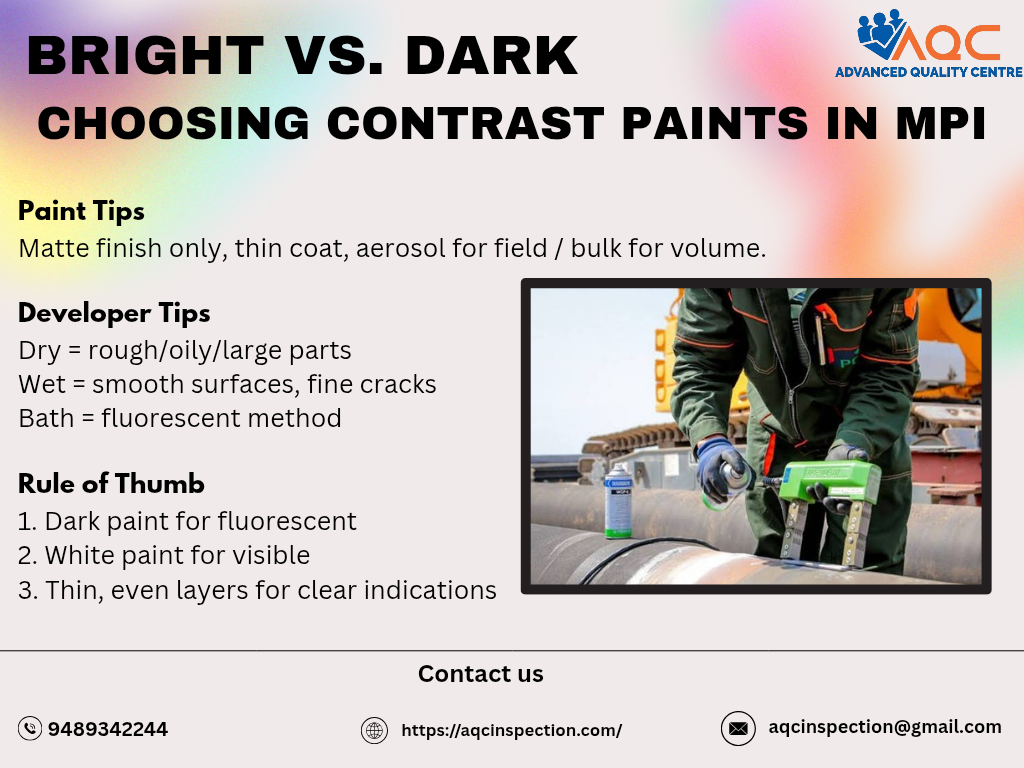
- Required Background: A non-fluorescent, flat dark contrast paint. A dark background will give the greatest contrast to the fluorescent particles bright yellow-green glow; a white or light background would wash out the fluorescence in normal light, and it would provide no benefit to fluorescence in UV light.
- Typical Developer: A wet suspension bath that is non-fluorescent or a dry powder.
- Visible Particles (a non-fluorescent type): This type of particle commonly is black, red, or grey and is checked under normal white light.
- Required Background: A light-coloured contrast paint. The white background will give dark black or red indications the most impact.
- Required Developer: For wet visible methods, a compatible liquid developer will create a white suspension. For dry visible methods, the particles themselves are usually applied without a separate developer, but you will still need a white contrast paint.
-
Selecting the Right Contrast Paint
Once you have identified the colour of the particle you can now select which contrast paint you want to use or if you want to use an aerosol can or a bulk liquid. Keep the following in mind:
- Aerosol vs. Bulk: Aerosol cans are very convenient for smaller jobs, field work, and parts with complex geometries.
- Drying Time: Fast-drying paint is available for high-throughput inspection work. Regular paint will take several more minutes to dry for a smooth even finish.
- Finish: The paint must dry to a completely flat/matte finish. A glossy and reflective finish can create glare when UV light is added and reflective surfaces can prevent fluorescent indications from becoming visible.
-
Choosing the Right Developer
The developer preformed is typically more active than the background paint. Your selection will depend on how you inspect.
- Dry Developers: This is a fine powder, usually white or grey, applied with a powder bulb gun or a specialized applicator.
- Best For: Surface has rough texture, hot or oily; large parts and field inspection. Good for locating indications that appear subsurface: The light powder creates additional minimal layer thickness allows for particles to create bulk indications.
- Considerations: Can be messy, good ventilation may need to be provided, and it is not suitable for confined spaces.
- Wet Developers: There are two forms of wet developers:
- Water-Suspended: A powder mixed with water; once the water evaporates, a white coating will remain.
- Non-water based (NAD/Solvent): A powder suspended in a volatile solvent; once the solvent flashes off, practically immediately, a white coating will remain.
- Best For: Smooth surfaces, batch processing of smaller parts, and the need for a thin, even developer film for most sensitivity to fine surface cracks.
- Considerations: NAD developers are highly flammable and need to be handled accordingly and have good ventilation as well. Water-based developers may cause corrosion on ferrous parts if not dried or an anti-corrosion agent is not used.
- Liquid Suspension (Bath) Developers: The liquid suspension used in the wet fluorescence method is the carrier medium. It holds the particles in suspension and, if properly formulated, leaves very little nonfluorescent film behind when dry. This film serves as the developer layer.
-
Application and Process Considerations
The best materials are of no value if improperly applied.
- Contrast Paint Application: Apply a thin, even coat. Thick, drippy applications can fill in shallow discontinuities so defects are not visible. Make sure fully dry before moving to the next step.
- Developer Application (Dry): Apply a very light, uniform dusting, as heavy applications can bury particle indications and not be seen.
- Developer Application (Wet): Make sure agitation and concentration is adequate (following the manufacturer’s specs). Dip or spray to have a thin, even film.
- Post-Inspection Cleanup: Always remove all residues (paint, developer, particles) after inspection. Buildup can interfere with subsequent processes like painting or welding and can mask defects after inspection.
Conclusion
Choosing the right types of contrast paints or developers is not a matter of chance, but a logical, sequential process based on basic principles of visibility and contrast. After you have established what your magnetic particle type is (fluorescent or visible), you will have restricted your selection to the appropriate background colour. After that, other factors such as the testing environment, surface condition and size of part will aid in selection of the form of developer (dry, wet, aqueous, non-aqueous). Following this logical method of selecting the correct contrast paint or developer and applying it to strict application protocols will significantly improve the reliability of your Magnetic Particle Inspection. You will have clearer indications of defects, improved odds of eliminating false calls or missed defects, and clearer contributions to the safety and health of the parts or components tested.
FAQ
Q1: Can I use a white contrast paint with fluorescent particles?
A: Absolutely not. White paint reflects white light, which will completely wash out the subtle yellow-green fluorescence under UV light, rendering your inspection useless. Always use a non-fluorescent dark grey or black paint.
Q2: What happens if I apply the MPI contrast paints too thickly?
A: A thick coat can fill in small, shallow surface cracks (like stress cracks or fatigue cracks), preventing the magnetic particles from being drawn into them. This drastically reduces the sensitivity of your test and can lead to a critical defect being missed.
Reference Sources
- ASTM E1444 – Standard Practice for Magnetic Particle Testing https://www.astm.org/e1444-22.html
- ASME Boiler and Pressure Vessel Code, Section V, Article 7 – Magnetic Particle Examination https://www.asme.org/codes-standards/find-codes-standards/bpvc-ix-bpvc-section-v-nondestructive-examination
- ISO 9934-1 Link: https://www.iso.org/standard/78799.html
- ISO 9934-2 Link: https://www.iso.org/standard/78800.html
- NDT Handbook, Volume 5: Magnetic Particle Testing https://asnt.org/store/detail/6e047a85-6c9e-ee11-8fff-6045bd9c5e0f
- Manufacturer Technical Data Sheets (TDS) Magnaflux: https://www.magnaflux.com/