
High-Demand Career in NDT & QC: Why This Field Is Booming in 2026
Have you ever wondered “How do we know this is safe?”, when you walk past a towering skyscraper, fly on an airplane, or drive across a large bridge? Well, the answer can be found in an important, mainly unseen world of guardians known as Nondestructive Testing and Quality Control professionals. Did you find yourself at a turning point in your life, considering moving from a theoretical career to a hands-on career, or simply looking for a stable and fulfilling vocation? The NDT & QC career field may be exactly for you. Completing a certified course adds a line to your resume, but more significantly opens doors in a worldwide industry ready for you to serve as an informed technician or inspector. This post will serve as a guide for exploring a job market with endless opportunity, defining required skills, and the career path that lies ahead for you once your NDT and QC certification journey begins
NDT vs QC: Key Differences, Roles, and Career Opportunities Explained
NDT (Non-Destructive Testing) and QC (Quality Control) are frequently spoken of together, but they represent separate and distinct fields while also being clearly interrelated. The NDT is the diagnostic side of the spectrum.
NDT technicians are the “doctors” of materials and structures; they engage in specialized techniques to inspect, test and evaluate the properties, or characteristics, of a component, weld, or structure without damaging, or compromising, the original integrity of it. The objective is to find flaws, cracks, corrosion, void or discontinuities that may affect safety. NDT is similar to medical ultrasound or an industrial x-ray.
QC (Quality Control) involves assurance and compliance – QC inspectors are the “guardians of standards.” They ensure that materials, products and processes conform to the exact specifications, codes and standards from beginning to end of a process. Quality control inspectors may utilize NDT techniques; however, their responsibility is more all-encompassing, which could involve documentation, procedure audits, and final sign off or verification prior to a product being approved for use.
Top Industries Hiring NDT & QC Professionals (Oil & Gas, Aerospace, Construction & More)
One of the great things about an NDT/QC qualification is its portability. You can take your skills anywhere, where structural integrity and quality are considered non-negotiable.
- Oil, Gas, and Petrochemicals: This is a traditional hotbed for NDT/QC efforts. Underwater pipelines, offshore platforms, storage tanks, and refinery pressure vessels require inspection or evaluation. The work is serious, steeper than other fields of practice, mainly to harsh work conditions and safety risks.
- Aerospace and Aviation: No room for error. NDT technicians evaluate aircraft components, engines, landing gear, and fuselage structures for tiny cracks and signs of fatigue. This field has the very highest level of quality assurance and certification.
- Power Generation: Whether nuclear, thermal, or wind power, NDT is a requirement. Inspections take place on components of nuclear reactors, blades of wind turbines, and welds of critical components in power generation facilities to ensure uninterrupted and safe energy.
- Manufacturing and Automotive: Inspections of the integrity of engine castings, welding on chassis, and rail tracks and wheels all involve NDT/QC professionals. These people’s primary role is to prevent failures of mass-produced items in manufacturing.
- Construction and Infrastructure: NDT is performed on the bridges, tunnels and stadiums we utilize. Technicians assess structural steel, pre-stressed concrete, and post-tension cables to determine they will perform for decades and also against natural forces.
Top NDT Methods You Must Learn: UT, RT, MT, PT & VT Explained
Often, your job will be defined by the types of NDT techniques you are certified for. The more methods you are trained in, the more marketable you are. These methods include:
- Ultrasonic Testing (UT): uses ultrasonic sound waves to locate internal defects.
- Radiographic Testing (RT): employs X-ray or gamma ray viewing of internal structures, much like a medical x-ray.
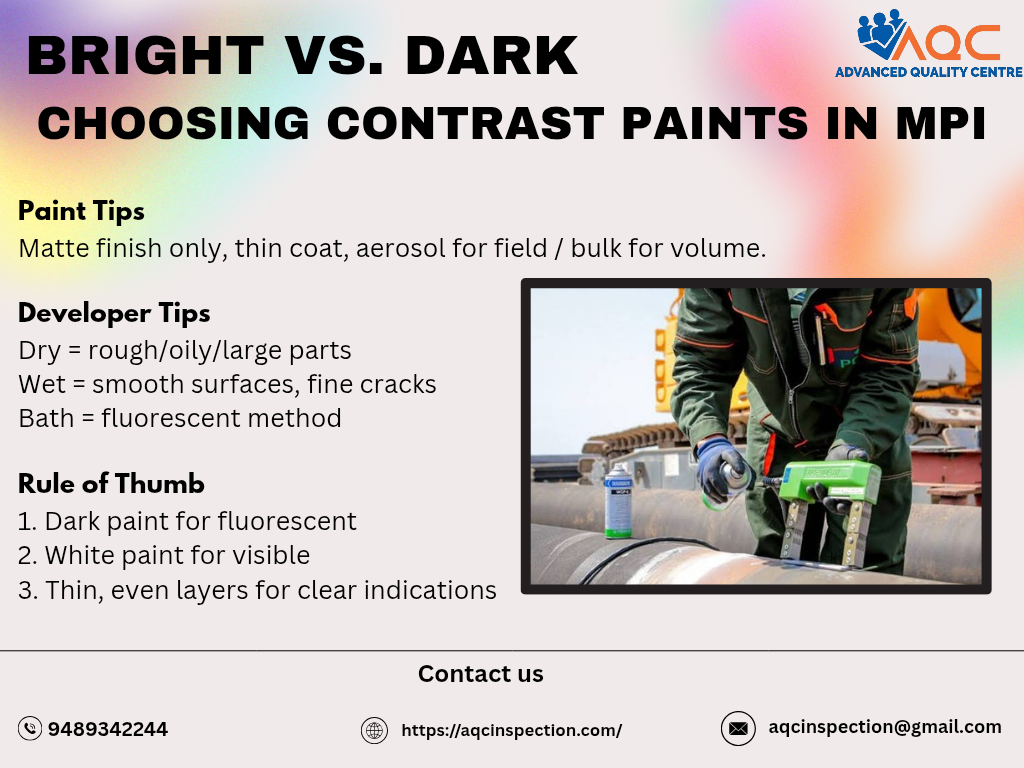
- Magnetic Particle Testing (MT): identifies surface and near-surface defects in ferromagnetic materials.
- Liquid Penetrant Testing (PT): a surface detection method that uses a visible or fluorescent liquid dye to detect weld or casting surface breaking defects.
- Visual Testing (VT): the simplest method, while often supplemented with borescopes and cameras (for remote viewing).
NDT Career Growth Path: From Trainee to Level III Inspector (Salary & Roles Guide)
No one should think that NDT/QC is a dead-end job; it is instead a straight-lined growth opportunity based on experience, certification, and responsibilities.
- Entry-Level (Trainee/Assistant): You begin in the capacity of an assistant to that individual already certified. You are going to work on-the-job learning. Salaries by now will be substantial and will move quickly as certification advances.
- Level I Technician: You will be certified in performing specific calibrations and tests under the supervision of a top-level technician.
- Level II Technician: This is the heart of the workforce. You are competent enough to set up and calibrate the equipment and for testing purposes interpret and assess results in accordance with codes and standards. This is where you will find your greatest technical growth.
- Level III/Senior Inspector: Technical expertise at one of the highest incoming jobs. The Level IIIs shall develop inspection procedures, supervise the methods being applied, interpret codes, and approve other personnel. They are the technical authority and consultants.
Essential Skills for NDT & QC Professionals: Technical + Soft Skills You Need
- Excellent Attention to Detail: A tiny crack can create a catastrophic failure. No mistakes can occur.
- Integrity and Ethics: You are the last defense. Reporting a defect is a requirement, even if it delays the project.
- Problem Solving Ability: Being able to decipher ambiguous data and uncover the rationale for a defect is very important.
- Stamina and Comfort in all Environments: The job may require working under high elevations, in constricted spaces, or in adverse environments.
- Strong Communication Skills: You need to have the capacity to write concise and clear reports and to convey the findings to engineers, managers, and clients.
How to Start a Career in NDT: Best Certifications (ISO 9712, SNT-TC-1A) Explained
To enter this career, you need formal training and certification. Look for respected training institutions that provide training in compliance with international certifications such as SNT-TC-1A or ISO 9712. These certifications are recognized worldwide and are your ticket to jobs throughout the world. Start with an entry-level method such as UT or RT and bundle in some other level of certification as you continue to grow professionally.
Conclusion: Why NDT & QC Is a Future-Proof Career with Global Job Opportunities
A career in NDT and QC is not a job; it is a career of significant responsibility. You will be one of the unsung professionals that millions of people will continue to rely upon every day for their safety. The career is a unique opportunity to perform hands-on technical work, constantly learn, and have the incredible satisfaction of knowing your work has a positive impact on society. It is an exciting career that is global and resilient in an economy; realms of hands-on talent and applying critical thinking will always be needed. So, if you are ready to build a career that matters, get ready for the rigorous environment of work in NDT and QC. The world is waiting for you, and you will be proud!
Reference Sources
For further reading and to verify certification paths, you can explore these authoritative sources:
- ASNT (The American Society for Nondestructive Testing): The largest global organization for NDT certification, standards and resources. https://www.asnt.org/, https://www.asnt.org/
- ICNDT (International Committee for Non-Destructive Testing): An international forum for NDT societies. https://www.icndt.org/ , https://www.icndt.org/
- ISO (International Organization for Standardization): For the ISO 9712 NDT certification standard. https://www.iso.org/, https://www.iso.org/
- AWS (American Welding Society): Provides some certification and other resources related to QC in welding which is a large application for NDT. https://www.aws.org/, https://www.aws.org/
- API (American Petroleum Institute): API has established many codes specifically for oil and gas. https://www.api.org/, https://www.api.org/


No Comments