Introduction
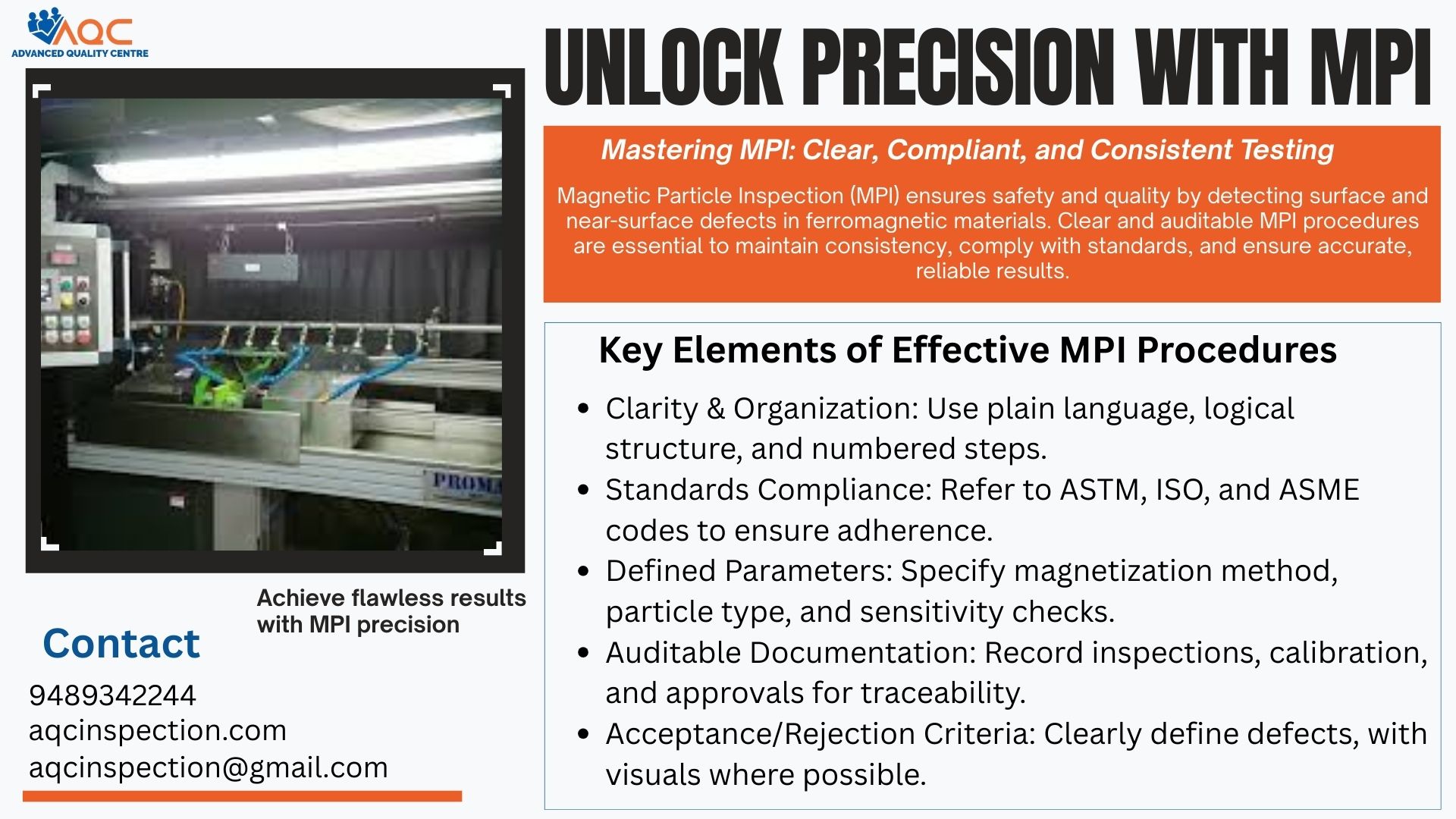
In any industry where Magnetic Particle Inspection (MPI) is used, whether it be aerospace, automotive, oil and gas, or power generation, the clarity and quality of MPI processes and procedures is critical. MPI is an NDT method used to find discontinuities, both surface and near-surface, in ferromagnetic materials. Although MPI is a very good NDT method, it relies on the processes and procedures that lead the technician through the inspection process, such as clarity and auditability. Badly written procedures can lead to inconsistent testing, missed defects, safety issues, and audit failures. Good procedures, which are clear, structured, and auditable, will provide an expected and known test process, comply with customer and regulatory requirements and provide confidence in inspection results.
-
Understanding MPI Procedures and Their Importance
MPI procedures are formal documents that indicate how magnetic particle testing (MPT) should be applied, and are usually specific to a given part, or material or product. It stipulates the necessary parameters, such as, MPT technique, magnetizing current, particle type, equipment settings, and acceptance criteria to be followed by the inspector.
Why Clear and Auditable Procedures are Important:
- Consistency, that ensures different inspectors produce equivalent outcomes.
- Traceability, where auditors and regulators can ensure compliance by.
- Safety, by ensuring catastrophic failures are not introduced by oversight of defects.
- Quality Assurance, which helps provide confidence to customers and stakeholders that the testing is in compliance with industry standards.
-
Acceptance Criteria for MPI Procedures
Acceptance criteria establish the built-in expectations that a MPI procedure is required to achieve in order to be effective and auditable. The major components are below:
a) Language and Organization
- Use plain language, not jargon, which may be confusing to inspectors.
- Organize the procedure logically, e.g., scope, roles and responsibilities, equipment, procedure, acceptance criteria, reporting, references, etc.
- Provide instructions in an easy-to-follow format, e.g., numbered steps and/or bullet points.
b) Standards Compliance
- Reference codes, standards, er specifications that are applicable. For example:
- ASTM E1444/E1444M: Standard Practice for Magnetic Particle Testing
- ISO 9934-1 Non-destructive testing – Magnetic particle testing
- ASME Boiler & Pressure Vessel Code, Section V
- Document and make it clear how the procedure is aligned with these standards.
c) Parameters Defined
- Indicate the magnetization method (longitudinal, circular, multi-directional, etc.)
- Specify current type and level (AC, HWDC, FWDC, etc.)
- Surface preparation, field strength and the type of particles used (fluorescent or visible).
- Specify the sensitivity checks and frequency of equipment calibration.
d) Auditable Documentation
- Listing of recordkeeping requirements: inspection logs, calibration certificates, or personnel qualifications.
- Controlled document revisions with a record of document history.
- Provide areas for the inspector’s signature, date, and approval.
e) Defined Acceptance/Rejection Criteria
- Provides clear definition of what is acceptable or rejectable indications.
- Diagrams or reference charts may be included, as appropriate.
- Acceptance criteria must link to customer requirements and codes.
-
Important Elements of a Clear and Auditable MPI Procedure
i) Scope and Purpose
Every procedure should begin with a statement of scope what material, part or component it applies to, and the reason to conduct MPI. This is to prevent the misapplication of the process.
For example: This procedure covers magnetic particle inspection of carbon steel weldments in pressure vessels in accordance with ASME Section V
ii) Responsibilities and Qualifications
This should identify who is responsible to conduct the inspection, as well as the certification (qualifications) that will be required.
For example: This inspection shall be carried out only by Level II or Level III NDT personnel certified to NAS 410
iii) Equipment and Materials
This should list all equipment, consumables, and calibration standards that are required:
- MPI Bench unit specifications
- Magnetic yokes or other portable equipment
- Black lights or white light meter
iv) Surface Preparation
Detail cleaning techniques that will remove any soil, paint or grease which could obfuscate defects.
“Surface shall be free of oil, grease, paint and other contaminants. Cleaning shall be performed with acetone or equivalent solvent.”
v) Magnetization Method
- Detail how magnetization will be done step by step:
- Method (circular, longitudinal, multi-directional)
- Voltage (AC, HWDC, FWDC)
- Amperage based on part geometry
- Duration of magnetization
vi) Application of Particles
- Application method (continuous vs. residual method)
- Medium used (dry powder, wet suspension)
- Concentration of wet baths• Agitation and settling checks
vii) Inspection Conditions
Define the visibility and environment.
- Minimum light for visible particles 100 foot-candles / 1000 lux.
- Minimum UV-A intensity for fluorescent particles (1000 µW/cm^2 @ 15 inches).
- Darkness for fluorescent.
viii) Indication Interpretation
- Provide a guidance on relevant or non-relevant indications:
- Relevant- cracks, laps, seams, inclusions
- Non-Relevant- machining marks, grind marks, geometry related signals
ix) Acceptance / Rejection Criteria
- Cite applicable code (e.g. “Linear indications >1.5 mm in length acceptable”).
- Illustrate with diagrams and/or photos Documentation and Reporting
x) Report templates should include:
- Part identification
- Date and inspector name
- Technique used
- Results (pass/fail, indication description)
- Signatures and approvals
xi) Audit Trail and Record Keeping.
- Define record retention time (i.e. 5 years).
- Record traceability – ensure traceability from equipment calibrating equipment to inspection report and final acceptance.
- Each procedure needs a revision history and must be approved by a Level III NDT authority.
-
Common Challenges and Ways to Deal with these
Challenge 1: Vague Instructions
Use a standardized format of wording to increase clarity, and flow charting to present a visual representation.
Challenge 2: Non-Compliance with Standards
Cross reference each procedure step and applicable standard, and develop a checklist
Challenge 3: Inadequate Documentation
Utilizing digital NDT reporting tools, or a standardized NDT logbook will ensure that everything you do is traceable by an auditor, both backwards and forwards.
-
Best Practices for Writing MPI Procedures
- Make it visual – utilize diagrams, methodologies, and images to augment your text.
- Modular – put all procedures into referenced sections, and break them down into short pieces.
- Same template – keep all procedures the same to regenerate across many parts or projects.
- Educate your inspectors – it is only as good as the people applying it.
- Complete an internal audit – perform mock audits so that you can assert the integrity of the procedures before they go through the audit.
Conclusion
Writing clear, auditable MPI procedures is not only about compliance it’s about safety, reliability, and customer confidence. Following the acceptance criteria in terms of clarity, compliance, parameters, documentation, and reject criteria, organizations can implement standardized inspections that pass audits with consistent quality between projects. As industry continues to demand higher quality assurance standards, well written, auditable MPI procedures will be key to non-destructive testing. For HR teams, safety managers, auditors, and NDT practitioners, we must maintain the principle that clear procedures create clear results.
FAQ
Which standards are most frequently used for MPI practices?
The most commonly used standards are:
- ASTM E1444/E1444M – Standard Practice for Magnetic Particle Testing
- ISO 9934-1 Non-destructive testing – Magnetic particle testing
- ASME Section V – Non-destructive Examination
- NAS 410 – Certification of NDT personnel
References
- ASTM E1444/E1444M – Standard Practice for Magnetic Particle Testing https://store.astm.org/
- ISO 9934-1:2016 – Non-destructive testing – Magnetic particle testing
- ASME Boiler & Pressure Vessel Code, Section V – Non-destructive Examination
- NAS 410 – Certification & Qualification of Non-destructive Testing Personnel
- Hellier, C. (2012). Handbook of Non-destructive Evaluation. McGraw-Hill Education.